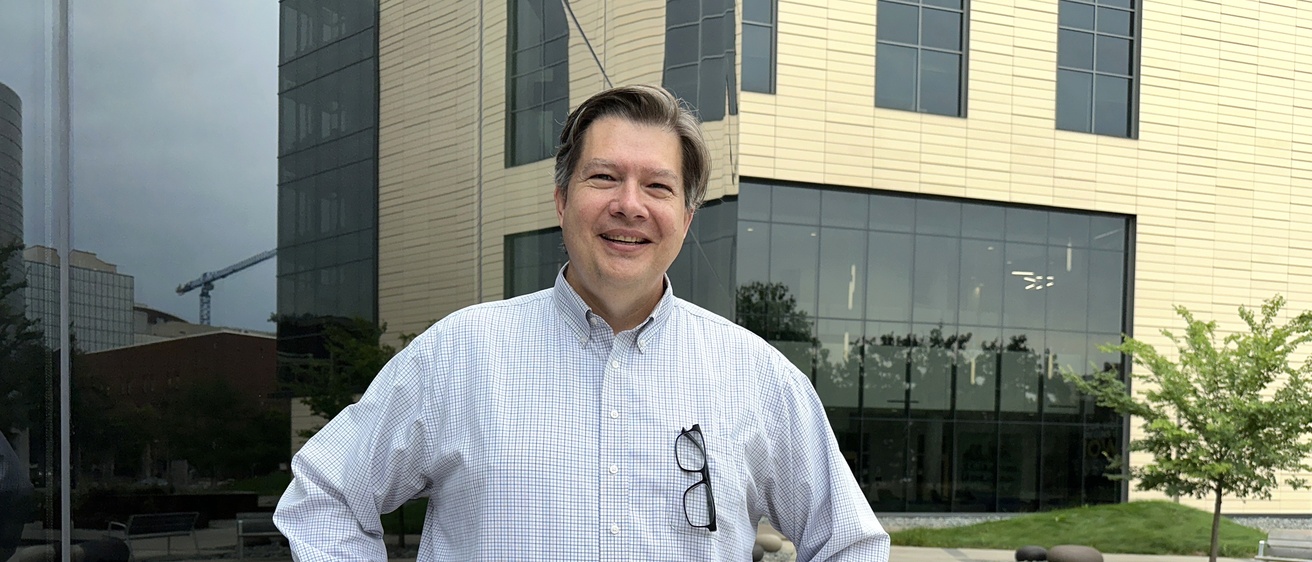
Lewis Stevens has accomplished a great deal in his career — working in national labs, industry, and academia — but what he’s found most rewarding is watching Doctor of Pharmacy (PharmD) and Doctor of Philosophy (PhD) students grow and succeed.
That’s just one reason Stevens is a teacher at his core.
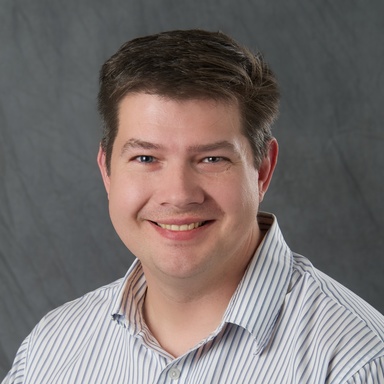
In recognition of his outstanding teaching, Stevens, associate professor and Pharmaceutics Program director, received the 2025 University of Iowa (UI) College of Pharmacy Collegiate Teacher of the Year Award — a recognition he describes as “a tremendous honor.”
“Teaching has always been a very meaningful part of my work, so to be acknowledged in this way by my students and colleagues means a great deal,” he said. “It’s a reflection not just of my efforts, but also of the supportive community that I’m very lucky to be part of.”
Stevens has worked in the college since 2012. He was drawn to the UI by the opportunity to mentor and connect with students, as well as the freedom to explore new strategies in drug development through his research — an area that has driven his academic career.
He comes from an interdisciplinary educational and research background that blends chemistry, materials science, and pharmaceutics. His work in a variety of settings has shaped a research approach and teaching philosophy based on understanding complex phenomena from first principles.
What initially inspired Stevens to pursue a career in pharmacy was the realization during his PhD studies at the University of Nebraska-Lincoln that even seemingly minor changes in how molecules are organized in the solid state can have a major impact on the material’s properties and their applications.
“That experience rooted a deep interest in the physical sciences and ultimately set me on the path I’m on today to develop better medicines by material design,” he explained.
Now, in his preformulation and solid-state design laboratory, where he works with PharmD and PhD students to engineer more effective and reliable drug products, Stevens is surrounded by fresh perspectives, thoughtful questions, and a curiosity that makes teaching and advising rewarding.
“Similarly, new discoveries and new connections uncovered by research group are a big part of what keeps my work exciting,” he said.
Stevens hopes to leave a lasting impact in the college by creating an environment in which students not only gain technical knowledge, but also learn to think critically, apply logic, and develop sound scientific reasoning, “What I call in many of my lectures their ‘intuition'," he said.
“In an era of essentially unlimited access to information (and disinformation), the ability to evaluate evidence, question assumptions, and make practical decisions is critically important,” Stevens said. “My goal is to help students build these essential skills, so they leave not only as knowledgeable experts, but also as thoughtful professionals capable of thinking for themselves.”