
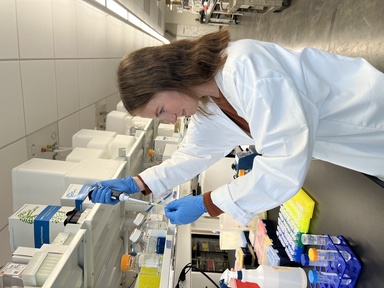
Rachel Crawford, graduate student in the College of Pharmacy, is making a name for herself in the field of toxicology.
Recently, she was awarded a National Research Service Award predoctoral fellowship from the National Institutes of Health (National Heart, Lung, and Blood Institute) for her project, “Cardiotoxicity of Catecholamine Metabolism by Monoamine Oxidase with Obesity.”
That’s an impressive accomplishment for Crawford — the principal investigator on the research — let alone for anyone in the field. Her advisor in the UI College of Pharmacy, Professor Ethan Anderson, explained that the success rate for these predoctoral grants is about one in seven. Crawford is only the second student in the history of the college to receive one.
A big deal, indeed.
“I know these fellowships are very difficult to get,” Crawford shared. “Even when I was preparing my proposal, it felt like kind of a long shot, but I also felt strongly about the work I was proposing and believed it was worthy of funding. And while I would’ve continued to believe in and pursue this same work whether or not I got this fellowship, it feels good to know that people at NIH also see the worth in what I’m doing.”
Crawford’s path to toxicology was a bit of a surprise. She earned her bachelor’s degree in biochemistry from Clarke University in Dubuque, Iowa, and initially planned to pursue a doctorate in the same area. But when she discovered that some schools offered toxicology programs — something she felt “made more sense” for her — her plans shifted.
“I realized I could still use a lot of my biochem background but also have more of an emphasis on public health and safety, which I also want to be a part of my career,” she said.
Crawford ultimately chose Iowa's human toxicology program for its interdisciplinary approach, which allowed her to explore the areas of toxicology that interested her most. She became particularly drawn to the research Anderson was doing, especially his focus on basic science practices and biochemical processes.
Her own research examines the enzyme monoamine oxidase in the heart. This enzyme metabolizes adrenaline and noradrenaline, producing toxic molecules that can damage heart cells. Recent work in the field has linked monoamine oxidase to several heart diseases. While its role in heart disease is well established, exactly what happens at the cellular level to cause the disease is still not fully understood. Crawford’s work aims to uncover the mechanisms underlying the toxicity of monoamine oxidase and its metabolites in the heart.
“This will help us better understand how we can most effectively treat or prevent some of these heart diseases,” Crawford said. “Ultimately, I hope my work can be used to inform future research developing improved treatments for these patients.”