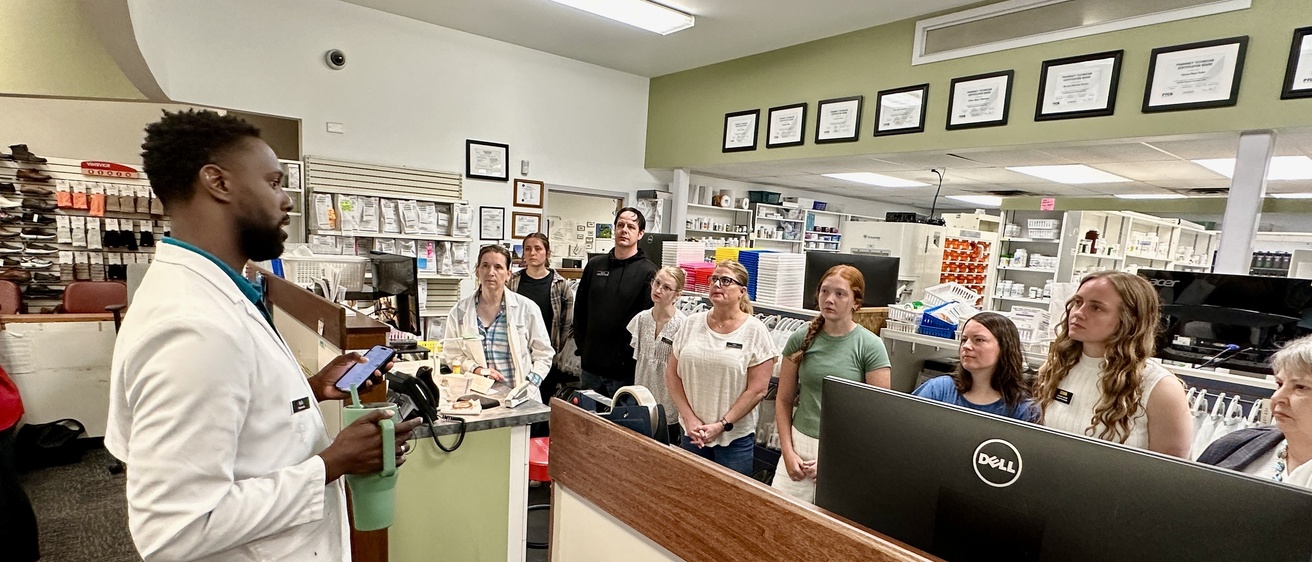
October is American Pharmacists Month. This year’s theme of Caring for Our Communities is an opportunity to celebrate the more than 700,000 pharmacists, technicians, and student pharmacists across the country who are devoted to improving public health and keeping communities safe. In community pharmacies and hospitals, pharmacists are a vital and accessible point of care.
Many of these heroes are at or came through the University of Iowa (UI) College of Pharmacy. The following stories highlight just a few of the many alumni making a difference in their communities and across health care.
A Lifetime of Service
In the mid-1960s, Paul Naber found himself at a crossroads. He was working as a chemist for the City of Cedar Rapids, and while it was fulfilling, it wasn’t supporting his family as well as he had hoped.
Naber began exploring new opportunities, including sales — a natural fit for his outgoing personality. His success in the role quickly led him to a pharmaceutical company in Illinois, where, within just three months, he became the top sales representative.

During a visit from his father, a conversation reminded him of his original goal to continue his education. Taking that advice to heart, Naber met with university leaders in Iowa City, where a dean encouraged him to consider pharmacy.
He soon enrolled at the UI College of Pharmacy, graduating in 1970. That decision set the course for a long and rewarding career devoted to patient care and community health.
Starting in a small community, Naber collaborated closely with a local doctor, then moved to an independent pharmacy. Soon after, Naber helped form MedSave, a buying group that set up pharmaceutical purchasing networks across the Midwest.
Years later, Naber moved to the Pacific Northwest, managing a 33-location grocery store pharmacy chain, Cost Cutter. After it went bankrupt in 2008, he worked at two independent pharmacies before returning to community-focused care in Sumas, Washington, where he partnered with a local physician and became a trusted member of the community’s health care team

“Serving patients in a small-town setting has been an incredibly fulfilling experience,” Naber said. “One of the most remarkable aspects is the strong sense of community and the deep, personal connections I’ve been able to build with my patients. In a small town, you often know your patients on a personal level, which allows for a more holistic approach to their health care.”
In 2020, Naber transitioned into a consulting role to share his expertise more broadly. One local example of his consulting work involved helping a friend identify a serious skin condition that required immediate cancer treatment and later assisting her husband in obtaining a life-improving medical device.
“These experiences reinforced the importance of compassion, empathy, and dedication in the health-care profession,” Naber said. “I encourage future pharmacists and health-care professionals to embrace these principles and strive to make a meaningful difference in the lives of those they serve.”
Naber credits his education at the UI College of Pharmacy for shaping his lifelong approach to pharmacy and instilling in him the importance of continuous learning.
“It allows me to leverage my years of experience and knowledge to make a lasting impact on the health-care community,” he said. “Overall, giving back in this way is a testament to my commitment to the health-care profession and my desire to contribute positively to the well-being of individuals and the community.”
Leading by Example
Michelle (Shellie) Fravel was drawn to pharmacy because she liked the idea of being a medication expert and using that knowledge to help both patients and health-care teams.
“I knew this would require ongoing learning to maintain expertise, and that seemed like a good and meaningful lifelong pursuit,” she said. “I also appreciated that there were multiple different avenues to pursue as a pharmacist, either practice in the community setting or in a hospital.”

Fravel soon learned there were even more opportunities within the profession, which further strengthened her interest. After earning her PharmD in 2006, she went on to complete a two-year ambulatory care residency. She currently works at UI Health Care as a clinical pharmacy specialist in ambulatory care, focusing on optimizing medication therapy for patients with kidney disease and management of anticoagulation.
Fravel also serves as a clinical professor at the UI College of Pharmacy, where she primarily teaches in the Pharmacy Practice Learning Center—hands-on training that spans the first three years of the PharmD curriculum and helps students build the core skills needed to become pharmacists. This role allows her to draw on her practice experience and clinical expertise to educate and mentor future pharmacy professionals.
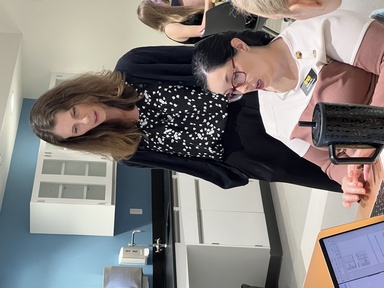
Besides teaching, Fravel serves as a faculty mentor, meeting regularly with students to help them achieve career goals. She’s also a preceptor for a fourth-year elective academic rotation, mentoring students interested in teaching.
To say Fravel keeps busy is an understatement, but she’s grateful for every opportunity.
“Working with students is the aspect of my career that has and continues to bring me the most joy,” she shared. “It is truly a privilege to have the opportunity to contribute to a student’s growth on their path to becoming a pharmacist.”
As Fravel looks to the future, she sees exciting possibilities — and big questions — on the horizon: How will the profession embrace AI to optimize medication therapy? What role will pharmacists play in advancing pharmacogenomics and personalized medicine? How will Standard of Care legislation shape collaboration across health-care professions?
“It’s an important time to be a pharmacist as there is a great need for educated professionals to advocate for the health-care needs of all patients,” she said.
Caring for Patients, Inspiring Learners
For Kelly Hoenig, '04 PharmD, program director of the PGY1 Pharmacy Residency (Ambulatory Care) at UI Health Care, working with pharmacy students and residents is a way to mentor the next generation of pharmacists.
“I love their curiosity for learning about medications and their passion for asking questions,” she shared. “A student can challenge my knowledge base and help me see things in different ways. I also enjoy the fresh energy they bring to their day and rotation experience. That energizes me, too.”
Hoenig hopes her learners gain a strong understanding of, and empathy for, the real-world implications and barriers to medication use in pediatric patients.

In her own work, Hoenig primarily focuses on self- or caregiver-administered injectable medications for complex skin conditions like severe atopic dermatitis and psoriasis. Patients and their families often have understandable fears about these medications.
“These medications are also very expensive with complex pathways to actually obtain access to,” Hoenig said. “I really enjoy exposing pharmacy students and residents to these processes so they can learn how to problem solve and provide excellent patient care in their professional futures.”
To assist pediatric patients and families using self-injectable medication, Hoenig conducts many in-person injection training visits where she can sit down with families, talk in depth about the medications, answer all their questions, and discuss their fears.
“We can practice with demonstration devices until they are comfortable with these injections,” she noted.
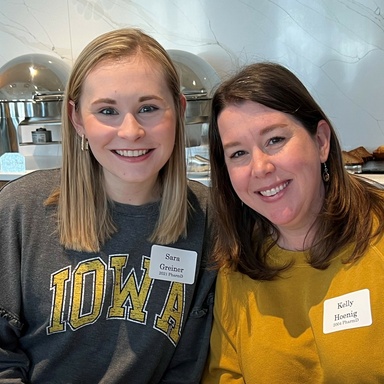
One of Hoenig’s most meaningful accomplishments in her career comes from her work with patients in the Pediatric Dermatology Clinic at UI Health Care who have severe and complex skin conditions.
“I am most proud of my impact in selecting appropriate therapies and helping patients maintain adherence to these medications,” she said. “This, in turn, improves their skin condition and quality of life. My pharmacy team within UI Health Care Specialty Pharmacy dramatically helps increase medication access. I then have multiple discussions with families about pain management strategies during uncomfortable injections and can provide meaningful strategies and interventions to increase a patient’s comfort.”
Ultimately, what brings Hoenig the most satisfaction is blending her patient care responsibilities with
pharmacy education.
“As a Residency Program director and a seasoned preceptor, I truly value working with learners,” she said.