
Eighty-nine University of Iowa (UI) Doctor of Pharmacy students were referred to as doctor for the first time May 14 at the Class of 2026 commencement. The previous evening, a special celebration honored graduates and recognized their accomplishments. Academic Excellence awards went to Eryka Dickey, Sarah Dodge, and Kevin Li. Holly Huynh earned a United States Public Health Service Award nomination.
Additional Notable Achievements
Students Receiving a Combined Doctor of Pharmacy/Master’s of Public Health Degree: 3
Students Receiving a Certificate in Palliative Care: 5
Percentile of Students Graduating with Highest Distinction: 11%
Students Receiving ExCEL Cords (Excellence in Community Engagement, Leaders, and Service): 36
Students Graduating as First-Generation Students: 17
Students Matching with a PGY1 Residency Program: 48
ASHP Residency Match Rate: 100%
Graduate Plans
Placement Type | Percentage of Class |
|---|---|
Employment | 29% |
Residency | 54% |
Still Determining Plans / | 17% |
Different Pursuits, Shared Purpose
The Class of 2026 is stepping into the next phase of their pharmacy careers with different goals, experiences, and ambitions — from community practice to health-system leadership. The college spoke with four graduates – two going directly into employment and two headed for residency – about what led them to pharmacy, the challenges of school, and how Iowa made them ready for what comes next.
Employment

Brooke Jasper’s interest in pharmacy became personal long before pharmacy school. Experiences helping family members through serious health conditions — including her mother’s hemorrhagic stroke and her grandfather’s cancer treatment — showed her the impact pharmacists can have on patients and families.
She found herself especially drawn to community pharmacy because of the accessibility and relationships built with patients across time. “Whether it’s an antibiotic that I’ve counseled numerous times before or a maintenance medication that’s a refill, there is always an opportunity to educate patients in a way that directly impacts their health outcomes,” Jasper said.
After earning her PharmD degree, Jasper will work as a staff pharmacist with Walmart in Manchester, Iowa. She said immediately entering the job market aligned best with her long-term goals in community practice and allowed her to continue developing skills in a patient-centered setting.
One of the biggest adjustments during pharmacy school, she said, was learning to apply information clinically instead of simply memorizing material for exams. “There is a lot of gray area in pharmacy practice,” Jasper said. “Clinical decision-making can seem challenging especially in fast-paced environments.”
She said Iowa’s combination of classroom instruction and repeated real-world experiential learning opportunities helped build her confidence. Exposure to a variety of pharmacy settings through Introductory Pharmacy Practice Experiences (IPPEs) and Advanced Pharmacy Practice Experiences (APPEs) strengthened her clinical judgment entering practice.
“I prepared intentionally for my rotations,” Jasper said. “For example, I reviewed common disease states and medication therapy management appropriate for the site and created quick reference guides.”
Some of Jasper’s favorite experiences came during rotations, particularly educating patients about diabetes management, insulin administration, and continuous glucose monitoring. “It is important for patients to receive proper education and helpful resources,” she said.
Her advice to future pharmacists entering employment is to stay curious and continue learning. “Pharmacy is an everchanging profession,” Jasper said. “We cannot know everything, but it’s important to understand how to use resources to form answers.”
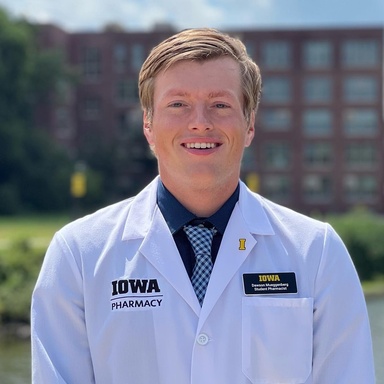
For Dawson Mueggenberg, pharmacy combined two long-standing interests: health care and science. What began as curiosity about chemistry and how medications affect the body eventually became a passion for helping patients understand and navigate their treatments. “I soon fell in love with pharmacy where I was able to make a direct difference in patients’ lives,” he said.
Mueggenberg always believed he would immediately enter the workforce after graduation. During an APPE rotation, he developed a strong connection with a hospital team and quickly realized he could see himself in the environment long term. When an opportunity opened, he pursued it, and soon will be an inpatient clinical pharmacist at Unity Point Health Hospital in Fort Dodge, Iowa.
While pharmacy school brought challenges — particularly pharmacokinetics — Mueggenberg said persistence and support from classmates and faculty helped him succeed. “It didn’t click with me immediately,” he said. “I overcame this by continuing to work through and problem solve examples.”
He credits the UI College of Pharmacy’s curriculum and experiential learning opportunities with preparing him to think critically rather than rely solely on memorization. Through coursework, rotations, and faculty mentorship, he said he feels prepared to manage complex clinical situations and advocate for patients.
Looking back, Mueggenberg said the friendships built throughout pharmacy school stand out most. “Getting through it together by studying, venting, or celebrating, is always something I will be grateful for,” he said.
His wisdom for future pharmacy students: build relationships early and approach every rotation professionally. “Take all rotations and networking events seriously,” he said. “They’re interviews you don’t know you’re having.”
Residency

Growing up, Ochain Okey rarely saw health-care professionals who looked like him. That experience shaped both his motivation to pursue pharmacy and his passion for improving patient understanding and trust within health care.
“Representation in health care is very important to me,” Okey said. “I want bridge that gap for people who may not fully understand why they were prescribed a medication.”
Although balancing coursework, employment, leadership involvement, and time with friends and family was challenging during pharmacy school, Okey said intentional time management helped him stay grounded. He cited friendships, Pharmacy Ball, and events shared with classmates as memories that stand out.
It was during a leadership APPE at Mayo Clinic that he decided to pursue residency. Conversations with pharmacy leaders there helped him envision a future in health-system leadership while remaining connected to patient care.
Okey matched into the PGY1/2 Health-System Pharmacy Administration and Leadership residency program at Abbott Northwestern Hospital through Allina Health in Minneapolis. He credits the UI College of Pharmacy with helping prepare him for residency through mentorship opportunities, leadership experiences, and the Active Residency Preparation course. “The earlier you get started on your CV, letter of intent, and interview practice, the better,” he advised PharmD students.
During residency, Okey hopes to further develop leadership, conflict resolution, and clinical skills while improving pharmacy operations and supporting pharmacy staff. For students considering residency, Okey emphasized professionalism and authenticity. “The pharmacy world is small,” he said. “Show up as yourself every day and stay curious.”

Hannah Tucker’s pharmacy journey began with a high school job in a pharmacy. This introduction gradually grew into a passion for patient care and continuous education. “Throughout school I’ve really grown to love the profession and the life-long learning that comes with it,” Tucker said.
After graduation, Tucker will expand her training through a PGY1 general residency at UW Medicine in Seattle, where she hopes to focus on acute-care rotations while working toward a career as an inpatient psychiatric pharmacist.
Interestingly, Tucker did not initially plan on a residency. It was during APPE rotations that she realized how much she enjoyed the acute-care setting and wanted further training. “I loved being on the acute side of patient care and loved how much I was learning,” she said. “I wanted another year (or two) to keep learning.”
One challenge Tucker faced during pharmacy school was finding balance during the program’s early years. She said prioritizing life outside of school helped her avoid burnout and remain more present academically and professionally.
Tucker credits Iowa faculty with helping shape her approach to patient-centered care while building strong clinical knowledge and professionalism. “The professors are great role models for students,” she said.
When asked about favorite memories from pharmacy school, Tucker immediately thought back to Engagement Week, held prior to classes starting. “I met two of my best friends during orientation week. They’re both very driven, which inspired me at the beginning of pharmacy school and is something I really admire about them,” Tucker said. “I couldn’t imagine the last four years without them!”
As she begins residency, Tucker hopes to strengthen her anticipatory clinical skills — particularly learning to predict provider questions and proactively preparing answers. “I had a few preceptors that were able to do this, and it helped the team immensely,” she said.
What would she tell students interested in residency? Stay open-minded and make connections. “I found my residency program through a pharmacist that knew a current resident there,” Tucker said. “I never would have looked into it if I hadn’t had a conversation with that pharmacist.”