
There’s no better place for a patient to determine their best care plan than through a one-on-one conversation with their health care provider. It’s a space to ask questions and drill down to what’s ailing them, what’s working, and what’s not.
For University of Iowa (UI) Patrick E. Keefe Associate Professor in Pharmacy Korey Kennelty, a geriatric pharmacist at UI Health Care Family Medicine, this is also where research begins.
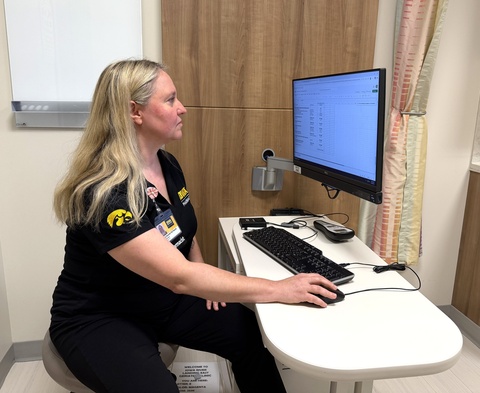
“Being in clinic keeps my research grounded in what's actually useful and feasible,” Kennelty said. “When I'm reviewing medications with an older adult who is managing several chronic conditions and over a dozen medications, I see firsthand where care can break down."
It’s this philosophy that led to Kennelty’s involvement in the Iowa Research Network (IRENE), a practice-based research network (PBRN) launched in 2001. It includes primary care physicians, advanced practice providers, and community pharmacists across the state who partner with researchers to study health care where it actually happens.
"A practice-based research network flips the starting point: the clinicians and pharmacists themselves help identify what questions matter, and the research happens in their own clinics and pharmacies, with their own patients,” explained Kennelty, who has served as IRENE director since 2023. “It’s research designed to be usable in everyday practice, not just publishable in a journal." IRENE is funded by the UI Department of Family and Community Medicine, private donations, and external research grants.
Broad Membership Range
IRENE has grown to 4,500 providers and nearly 2,000 pharmacists. It employs an opt-out membership model, meaning primary care practices and community pharmacies are considered members unless they decline participation.

“This creates a more representative network by including a broader range of practices and pharmacies — large and small, urban and rural, and those with varying levels of research experience,” Kennelty said. “As a result, research findings are more reflective of real-world clinical care and are more generalizable to the populations served across Iowa.”
She added that this automatic membership doesn’t mean practices must partake in studies. Instead, members learn about research opportunities and decide whether to join based on their interests, capacity, and priorities. How many and what types of patients a clinic regularly sees also can be a qualifier.
Projects Underway
This is the case with a five-year, $17.9 million clinical trial funded by the Patient-Centered Outcomes Research Institute (PCORI) on which Kennelty and Carri Casteel, professor in the UI Department of Occupational and Environmental Health, are dual-principal investigators. The research focuses on two team-based models for managing high blood pressure in older adults with multiple chronic conditions using self-measured blood pressures (SMBP). They are recruiting 10 IRENE clinics to join UI Health Care sites already active.
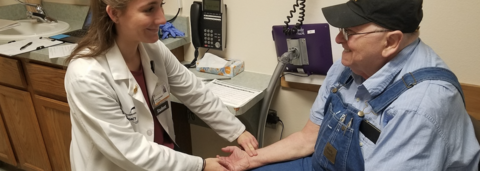
“The best-fit clinics are ones already seeing a steady volume of older adults with high blood pressure and multiple chronic conditions, and that have at least one staff member — often a nurse, medical assistant, or pharmacist — who can champion the workflow,” said Kennelty.
Patients in the study take home a blood pressure monitor, record readings on their own, and the clinic reviews data and adjusts the care plan accordingly across a 12-month period. “It fits into existing visit patterns rather than creating a parallel process,” Kennelty noted.
A second groundbreaking initiative on which IRENE is involved is a five-year community-pharmacy based study aimed at improving lung cancer screening rates in Iowa. Only about 20 percent of eligible Iowans receive an annual lung cancer screening. The Community Health Assessment and Monitoring in the Pharmacy (CHAMP) launched earlier this year and is supported by Eli Lilly and Company.

“Pharmacies are where people already are,” Kennelty said. “Iowans visit their community pharmacy roughly two times more often than they see their primary care provider, so a pharmacist has far more chances to ask the right question at the right time — and pharmacists already have a trusted relationship.”
UI College of Pharmacy Dean, Jean M. Schmidt Chair, and Professor Jill Kolesar is the principal investigator, while the Iowa Pharmacists Association and CPESN Iowa are collaborators. Phase I is a three-year partnership with IRENE member Greenwood Pharmacy and Cedar Valley Clinical Research in Waterloo, Iowa. During a routine pharmacy visit, a pharmacist prescreens patients to assess eligibility. Those who meet criteria can opt to receive a blood test to assess their likelihood of having detectable lung cancer. Further evaluation follows any positive results. There will be 500 participants enrolled.
According to Kennelty, once a workflow process is established, the plan is to expand to 10 additional IRENE community pharmacies in years two and three. “Ultimately we want to make this a model most community pharmacies in the country could adopt,” she said. IRENE also has submitted a proposal to PCORI to develop and test a strategy to increase patient and caregiver engagement in research projects.
“Patients and caregivers are the ones living with the day-to-day reality of a health condition, so they often see problems — and possible solutions — that researchers simply can't see from the outside,” Kennelty said. “Treating them as team members rather than subjects means they help shape the research question itself, not just consent to be studied, which tends to produce research that's more relevant and more likely to actually get used in practice.”

Success Then Scale
For Kennelty, IRENE’s success in five years would be Iowa clinics and pharmacies — especially in rural counties — recognizing that they are partners in leading research, not just sites where research happens.
“Concretely, that means a larger and more diverse network, projects like SMBP and CHAMP, scaled well beyond their pilot sites, and findings that have visibly changed how care is delivered in communities where the research happened.”
A solid step in that direction is the Meta-network Learning and Research Center (Meta-LARC). IRENE is one of the founding members of the consortium connecting nine PBRNs comprised of 1,000 primary care practices and 7,000 clinicians caring for more than 3 million patients across United States rural, urban, and underserved communities.
“That scale matters because it lets us take on large, multi-site clinical trials and practice-transformation projects that a single-state network couldn't support alone,” noted Kennelty, who in 2024 was elected Meta-LARC chair.
Meanwhile, Kennelty is proud of IRENE’s continued progress, from expanding the network to strengthening its ability to conduct research that reflects realities of everyday clinical care. “Our growth has created more opportunities for clinics and pharmacies to engage in research that addresses questions important to their patients and communities,” she said.