Pharmaceuticals research isn’t just about finding the right properties for a single drug to effectively treat disease. Part of discovering and improving medicine is creating new therapeutic road maps. Often that pathway arcs from an investigator’s research history — what they’ve seen across the years and where they think it’s going.
Broad Research

The National Institutes of Health (NIH) R35 grant mechanism supports that breadth. It gives researchers freedom to pivot their science toward emerging trends or follow new, unexpected results without prior approval for scope changes, unlike the more common NIH R01 grant, which is tied to specific aims. The NIH saw the promise in the research body of University of Iowa College of Pharmacy Professor Michael Ashley Spies and awarded him a $2 million, five-year grant last year to explore the potential of protein allosteric pockets in drug design.
“This research is about finding new ways to fight disease in places we haven’t looked before and building the tools to do it smarter,” said Spies, the award’s principal investigator. “It’s a real vote of confidence from the NIH and I don’t take that lightly.”
Secret Pockets Potential
The grant allows Spies, who works in the college’s Drug Discovery and Experimental Therapeutics program, to unite two previous R01-funded enzymatic research threads under one cohesive framework. The first is glutamate racemase, a protein that bacteria use to survive. The second is caspase-7, an enzyme that helps carry out apoptosis — the body’s controlled cell-death program. “The integration felt natural because the underlying questions were always connected,” he said.
More specifically, Spies’ lab is trying to understand the promise of allosteric drugs and why that promise hasn’t yet been fully realized. Allosteric pockets are more remote sites on enzyme proteins, away from the active core orthosteric sites where chemical action happens and most drug design logic traditionally has pointed.
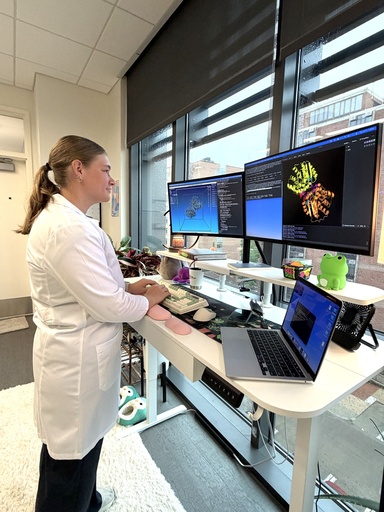
“Think of them like a secret compartment that you can’t even tell is there until the protein moves in just the right way and opens it up,” explained Spies. “The protein’s own natural motion reveals the pocket. The idea is that there are hidden signals embedded in the way the enzyme moves, signals that can give us real clues about how to design better drugs.”
According to Spies, what makes these allosteric cavities attractive is they sometimes offer greater opportunity — they can be larger, more accessible, and more chemically "friendly" for a drug molecule to bind. He added that not every enzyme has these useful cryptic pockets.
“Some aren’t highly flexible and don't respond at all, so the approach doesn't apply universally,” said Spies. “But for the enzymes where it works, it opens up a whole different avenue.”
Unanswered Questions
Along with the potential comes scientific mystery.
“Why does binding something at that remote location actually shut the enzyme down,” asked Spies. “The chemistry is happening far away — so how does a molecule sitting in this distant pocket reach across and change what the enzyme is doing? That's the question I'm genuinely trying to answer. The more you dig into it, the more you realize it's not fully understood, including how it translates into something that can affect disease.”
Two examples Spies gave of health conditions his work could impact are gastric cancer and Parkinson’s disease – plus neuroinflammatory conditions more broadly.
“The goal is to walk away with something that functions like a new language for allosteric drug design that other researchers and drug designers can actually use,” said Spies. “We’re off to a strong start and I’m excited about where things are going.”